
Heart Rate Variability (HRV) ❦ Training
Train Your Nervous System. Improve Your Health. Extend Your Resilience.
The HeartMath® Institute Research Center is the leader in exploring the physiological mechanisms by which the heart and brain communicate and how the activity of the heart influences our perceptions, emotions, intuition and health. In the early 1990s, The HeartMath® Institute were among the first to conduct research that not only looked at how stressful emotions affect the activity in the autonomic nervous system (ANS) and the hormonal and immune systems, but also the effects of emotions such as appreciation, compassion and care. Over the years, The HeartMath® Institute has conducted many studies that have utilized different physiological measures such as: EEG (brain waves), SCL (skin conductance), ECG (heart), BP (blood pressure) and hormone levels. However, heart rate variability (HRV) consistently stands out as the most dynamic and reflective indicator of one's emotional states and autonomic nervous system dynamics based on their findings.
Why Does HRV Matter?
HRV is one of our bodies most powerful signals and one of the strongest indicators of overall health, resilience, and longevity. HRV training can help us learn to listen to that signal and respond in ways that optimize our autonomic nervous system, improve physiological balance, and support long-term well-being
So What Is Exactly is HRV?
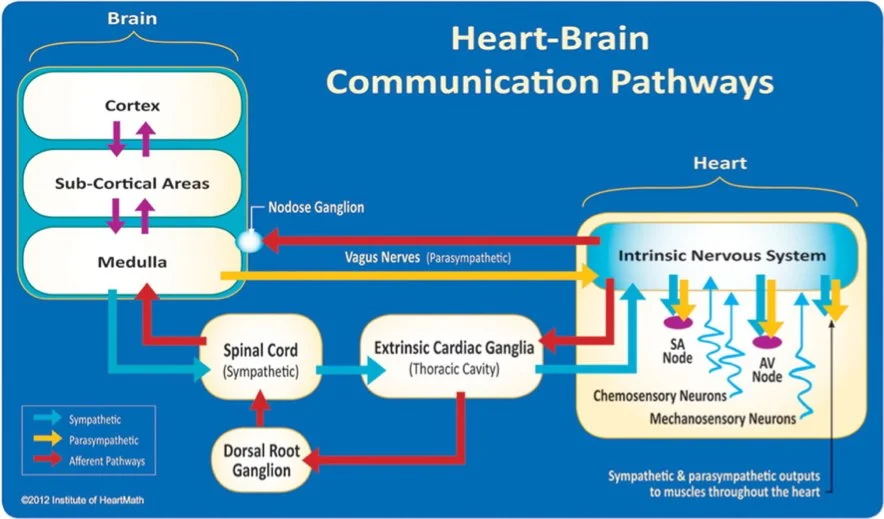
Heart Rate Variability refers to the subtle variation in time between each heartbeat. HRV and brain waves reflect two sides of the same regulatory system: the autonomic nervous system. While they are measured differently, HRV from the ♥️ and 🧠 waves from EEG, the heart and brain rhythms often synchronize functionally during states of optimal regulation, focus, and recovery. Traditionally, the study of communication pathways between the brain & the heart has been approached from a rather one-sided perspective, with the focus being primarily on the heart's responses to the brain's commands. However, the communication between the heart and brain is a dynamic, ongoing, two-way dialogue, with each organ continuously influencing the other's function. Research has shown that the heart communicates to the brain in four major ways: neurologically (through the transmission of nerve impulses), biochemically (via hormones and neurotransmitters), biophysically (through pressure waves) and energetically (through electromagnetic field interactions). Communication along all these conduits significantly affects the brain's activity and our performance. The anatomy and functions of the intrinsic cardiac nervous system and its connections with the brain have been explored extensively in the field of neurocardiology. In terms of heart-brain communication, it is generally well-known that the efferent (descending, CNS to PNS) pathways in the autonomic nervous system are involved in the regulation of the heart. However, it is less appreciated that the majority of fibers in the vagus nerves are afferent (ascending, PNS to CNS) in nature. This means the heart sends more information to the brain than the brain sends to the heart. More recent research shows that the neural interactions between the heart and brain are more complex than previously thought. In addition, the intrinsic cardiac nervous system has both short-term and long-term memory functions and can operate independently of central neuronal command.
The above may seem like a lot of information, but in short, the main take-away is that the heart regulates the brain by sending rhythmic, vagally mediated signals that organize brain wave activity. Thus, the way we feel affects the way we think. Below is a visual diagram.

-
Cardiovascular disease (hypertension, coronary artery disease, heart failure)
Metabolic dysfunction (insulin resistance, metabolic syndrome, type 2 diabetes)
Chronic inflammatory and autoimmune conditions
Anxiety disorders, depression, PTSD, and chronic stress states
Neurodegenerative conditions and cognitive decline
Sleep disorders, including insomnia and sleep apnea
Chronic pain syndromes and fibromyalgia
Hormonal imbalances (thyroid dysfunction, adrenal dysregulation, menopause-related changes)
Acute and chronic infections
Post-viral syndromes and prolonged illness recovery
-
Sleep duration, quality, and circadian rhythm alignment
Psychological stress and emotional load
Physical training load, overtraining, and inadequate recovery
Blood sugar stability and metabolic flexibility
Nutrient sufficiency and protein intake
Alcohol consumption and stimulant use
Sedentary behavior
Restorative movement
Hydration and electrolyte imbalance
Environmental stressors (noise, light exposure, heat, altitude)
Work demands, travel, and irregular schedules
-
Resonance frequency breathing
HRV biofeedback and guided nervous system training
Stress recovery and parasympathetic activation techniques
Sleep optimization strategies
Exercise programming that balances stimulus and recovery
Mindfulness, meditation, and interoceptive awareness practices
Nutrition strategies that support metabolic and nervous system health
Consistent monitoring of HRV trends over time
Integrating HRV insights into daily decision-making
Long-term nervous system resilience and adaptability training
The Shared Language: Rhythms and Oscillations
Both the heart and the brain operate through oscillatory patterns:
HRV waves reflect rhythmic changes in autonomic nervous system activity
Brain waves reflect rhythmic electrical activity of neuronal networks
When the nervous system is well-regulated, these rhythms become coherent, meaning they communicate efficiently and reinforce one another. The autonomic nervous system is the part of the nervous system that controls the body's internal functions, including heart rate, gastrointestinal tract and secretions of many glands. The ANS also controls many other vital activities such as respiration and it interacts with immune and hormonal system functions. Both mental and emotional states directly affect activity in the ANS.
When HRV is coherent (High HRV):
Signals from the heart become rhythmic and predictable
The brain synchronizes its electrical activity accordingly
Emotional centers (amygdala) quiet and increased alpha & theta brain wave activity take place
Executive centers (prefrontal cortex) regain control
Mitochondrial repair
Optimal heart rate recovery (HRR)
This pattern is common in those experiencing stress resilience, emotional regulation, high cognitive performance, and optimal physiological health.
When HRV is incoherent (Low HRV):
Excess high-beta brain wave activity (stress, anxiety, rumination)
Reduced alpha and theta brain wave activity
Impaired emotional regulation and focus
Immunosuppression
Slowed cognition and memory
Systemic inflammation
Mitochondrial dysfunction
Weakened heart rate recovery (HRR)
This pattern is common in those experiencing chronic stress, trauma, sleep deprivation, Metabolic breakdown, cellular exhaustion and burnout.
Pricing:
HRV Training Single Session Price
60-Minute Session $125
HRV Training Packages
Package of 10 Sessions, $1,000
Package of 5 Sessions, $500